Use Search when you need closer control over search intent, ad copy, and landing pages. Use Performance Max when you want automated delivery across Google channels and can supply reliable conversion data, suitable creative, and, for Shopping ads, a healthy product feed. Many ecommerce accounts use both. Allocate budget by their contribution to sales and profit, not by campaign ROAS alone.
I do not ask which campaign type is universally better. I ask what the business needs next. If the account needs clearer control over high-value query themes, Search may deserve more attention. If product coverage and conversion signals are reliable and the account needs broader automated discovery, Performance Max may be useful. Many brands need both, but not necessarily with the same target or interpretation.
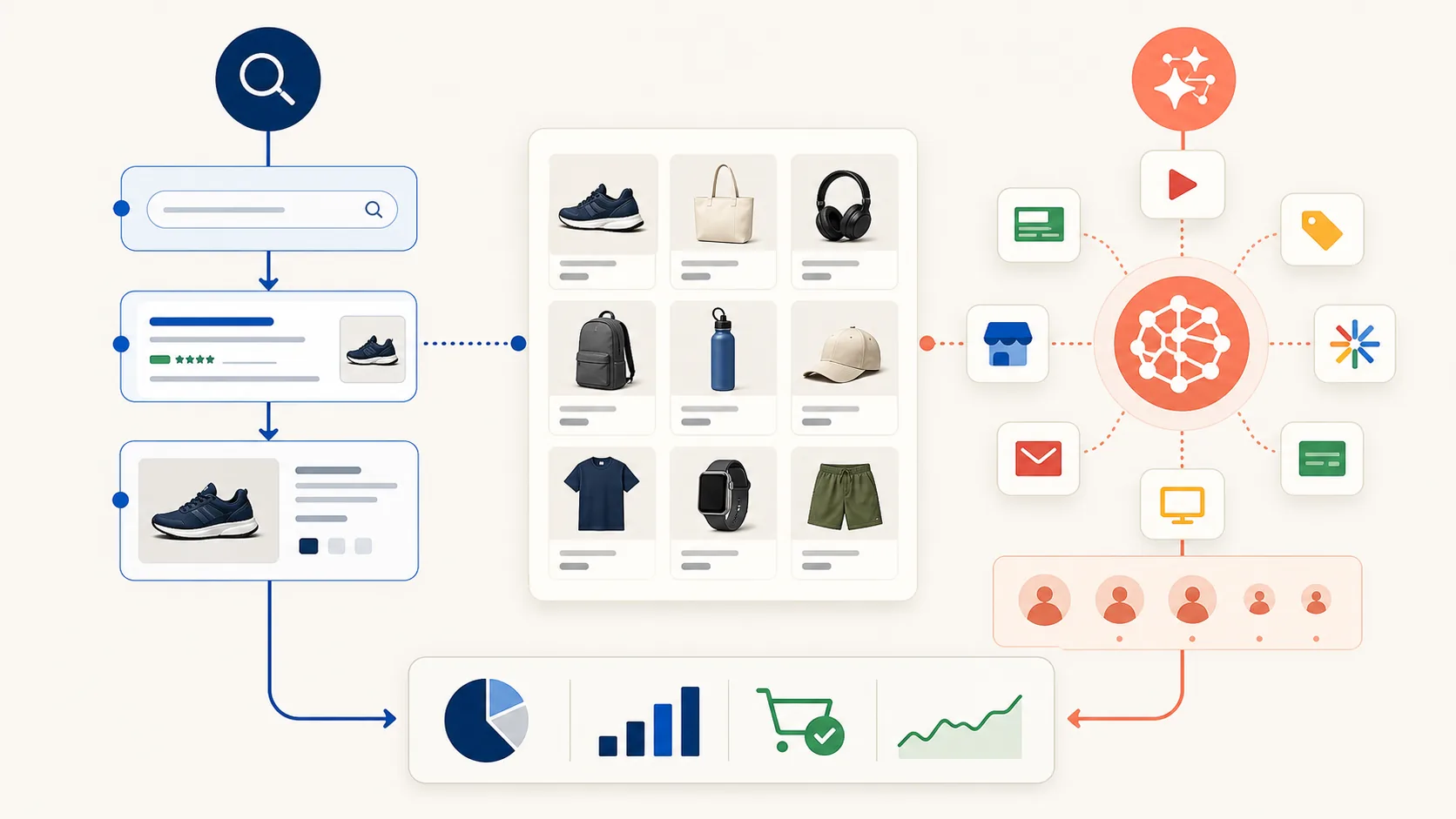
The role of each campaign type
Search is useful for reaching people whose queries match a specific product, category, or brand. It can organize brand, category, product, and competitor themes around the questions the business wants to answer. Performance Max is usually strongest when the account can provide clean product data and meaningful conversion signals, and when the team accepts a broader mix of placements and automated decisions.
Google describes Performance Max as a goal-based campaign type that can serve across its advertising inventory. That reach is why I evaluate it differently from a Search campaign built around explicit query controls.
- Search helps make query intent, messaging, and landing-page choices more visible.
- Performance Max can connect product data, creative, audiences, and automated placement decisions.
- Both need accurate tracking, healthy landing pages, and a clear business goal.
What Search gives you more control over
Search lets me decide which themes get a budget, which messages appear, and which landing pages support the click. I can inspect search terms more directly, add negatives, isolate locations, and separate campaigns when the account needs a different target or report. That control is valuable when the business has materially different margins, product priorities, or brand protection requirements.
Control does not mean guaranteed incrementality
A brand Search campaign can report efficient conversions because the shopper already intended to buy. Clearer query control improves interpretation, but it does not make every conversion incremental. I use Search as a measurement and coverage control point, then compare it with total account behavior and broader demand signals.
What Performance Max automates
Performance Max makes more decisions across the path from product data and audience or intent signals to placement and bidding. That can help an account find opportunities a tightly controlled Search structure would not reach, but it also makes it harder to attribute the result to one visible query or placement. The campaign needs useful inputs and a role the team can evaluate without expecting complete transparency.
I check conversion goals, feed quality, product grouping, asset coverage, URL behavior, brand overlap, new-customer settings, and budget constraints before deciding that the target is the problem. My approach to Performance Max cleanup starts with those inputs because a target cannot compensate for weak conversion signals or missing product coverage.
I explain the rest of that process in this practical Performance Max cleanup sequence.
Brand overlap and query visibility
One of the most common interpretation problems is branded demand inside Performance Max. Brand searches can convert efficiently and raise the campaign average while saying little about what the next non-brand dollar will create. I review Search coverage, PMax search insights, product names, brand-plus-category terms, returning-customer patterns, and changes in total account performance together.
The branded demand and Performance Max guide explains how I baseline and test this overlap without treating brand conversions as worthless.
Why account economics matter more than campaign ROAS
A campaign-level ROAS can be useful, but it is not the business decision. I want to know whether the account is producing profitable revenue, how much demand was already present, what products received the spend, whether the customer mix changed, and what happens when budget moves. The next dollar should be judged against contribution margin, inventory, customer value, and opportunity cost.
- Separate brand capture from generic demand when the budget decision depends on the difference.
- Review category, product, margin, and inventory mix instead of relying on one blended average.
- Include conversion lag, promotions, price changes, and feed changes in the comparison window.
- Compare total account outcomes before and after a campaign-level change.
A practical budget framework
I usually think about the budget in layers. First, protect the demand the business needs to capture. Second, fund the campaigns that can create or harvest the most valuable non-brand demand. Third, reserve a measured portion for tests where the account can define a question and a stop condition. The proportions depend on the business, so I avoid presenting a universal split as a rule.
The framework should also account for operational attention. If a team cannot maintain feed quality, landing pages, creative assets, and reporting for another campaign type, the theoretical opportunity may not be worth the execution risk.
How to run a cleaner comparison
I document the baseline before changing the account. That includes spend, conversions, value, impression share where available, brand coverage, product eligibility, major promotions, inventory, and conversion settings. Then I make the smallest change that answers the question, hold other material variables steady where possible, and record the timing.
- Use a period long enough to include conversion lag and normal weekly variation.
- Keep conversion definitions and value rules consistent across the comparison.
- Record changes to brand exclusions, negatives, targets, budgets, feed labels, and landing pages.
- Review total account revenue and margin indicators alongside campaign metrics.
- Decide in advance what evidence would justify scaling, holding, or reversing the test.
When to use both, one, or neither
Use both when the jobs are different
Search and Performance Max can work together when Search protects important query control and Performance Max adds broader product or placement coverage. The account needs enough separation to interpret overlap, plus a reporting view that does not encourage every budget conversation to begin with one campaign ROAS number.
Use one when the account needs focus
A smaller catalog, limited budget, weak tracking, or unstable feed may call for a simpler structure. A campaign that is technically available is not automatically the campaign the business should prioritize. I would rather make one role clear and measurable than launch two systems the team cannot maintain.
Use neither when the inputs are not ready
If the store cannot fulfill demand, the conversion action is unreliable, product data is inaccurate, or landing pages are not usable, changing campaign type is unlikely to solve the underlying problem. Fix the constraint first, then decide which campaign can use the improved input.
For a full account review, see the ecommerce PPC management service or use Dashboard for reporting and reviewed next steps.